No Arbitrary Higher Tax Can Be Imposed When Presumptive Income Is Properly Declared: ITAT
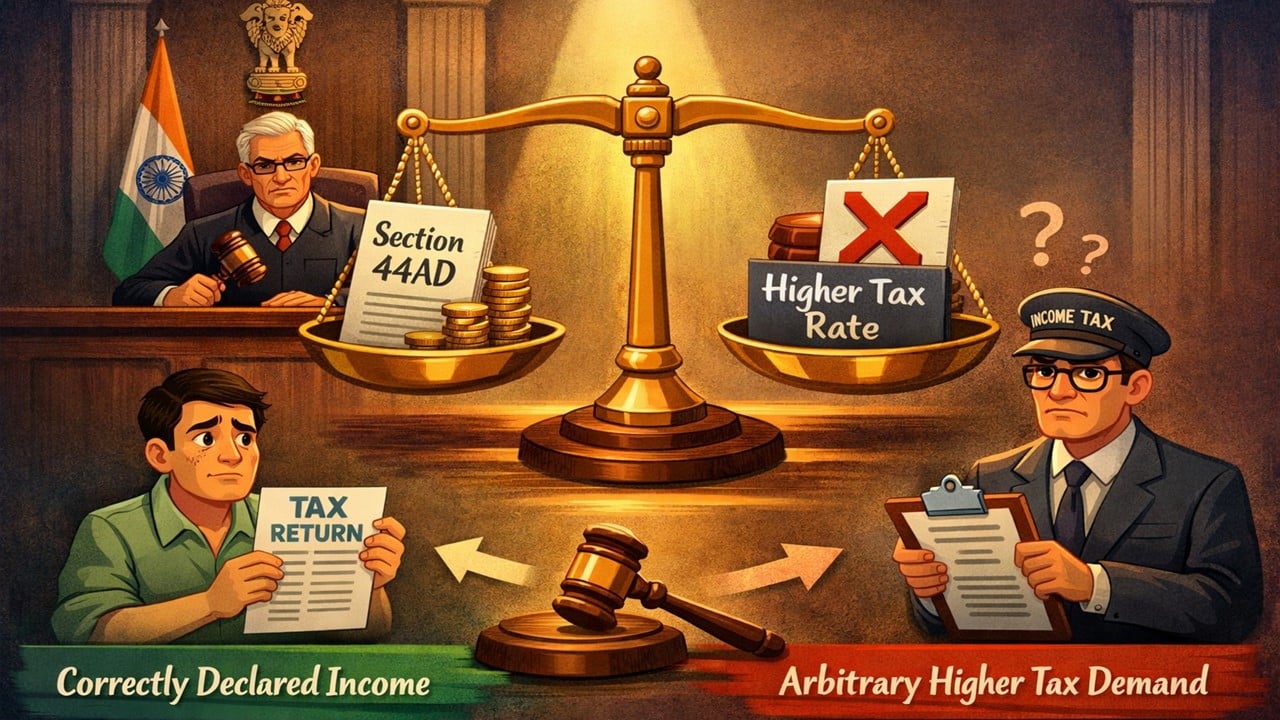
No Arbitrary Higher Tax Can Be Imposed When Presumptive Income Is Properly Declared: ITAT
The Income Tax Appellate Tribunal (ITAT), Mumbai, in a recent case, held that once a taxpayer has properly opted for Section 44D and declared sufficient income, the tax authorities cannot levy a higher rate without proper reasons.
The assessee had initially declared its total income at Rs 492,220. During the assessment of the return, the tax authorities had noticed income escapement; income amounting to Rs 2.16 crore remained unexplained. In conclusion, the assessee was issued with a show cause notice (SCN), asking him to explain the source of income.
In response to the notice, the assessee responded that he worked as a Business Correspondent (BC) with Fino Payments Bank Ltd, where the bank account in question was used to handle transactions on behalf of customers. He further claimed that the deposits did not pertain to him and he had earned a minor commission from these transactions falling under the presumptive taxation scheme (Section 44AD).
The assessee claimed that “It is engaged in the activity of a Business Correspondent (BC) with Fino Payments Bank Ltd. The assessee has consistently maintained that the bank account in question is a BC Merchant Account, wherein transactions are carried out on behalf of customers and only commission income accrues to the assessee.”
However, the tax authorities did not consider his explanation and applied a higher income estimation of 50% of gross receipts of Rs 1,485,694, concluding an addition amounting to Rs 215,389 to the assessee’s income. As a result, the tax authorities assessed the total income at Rs 707,609.
When the assessee approached the ITAT Mumbai, the tribunal noted that the assessee’s work as a Business Correspondent was a business activity, not a professional service. Therefore, applying the 50% presumptive rate meant for professionals was incorrect. The Tribunal noted that assessees had already declared income higher than the minimum required under Section 44AD.
The tribunal held that the approach followed by the tax officer was legally incorrect and arbitrary. It held that the tax department does not have the authority to impose a higher rate without valid grounds if a taxpayer has properly opted for Section 44D and declared sufficient income. As a result, the tribunal ruled in favour of the assessee by deleting the impugned addition.